
Paving Contractors and Installers in Penrith
Paving Penrith
Driveways, patios and paths laid on a proper base, so they stay put.
Pavers that have started to rock underfoot, a driveway sinking into two wheel ruts, water pooling by the back door after every storm. That is usually what has you looking for a paver. Most of those problems trace back to one thing: the base. Get the groundwork right and a paved area sits flat and solid for decades. Skip it and no amount of nice pavers will save the job.
Proper base
Excavated, road-based and compacted so pavers do not sink or shift.
Drains right
Falls set away from the house so water runs off instead of pooling.
You pick the schedule
Concrete, clay brick or natural stone matched to the job and budget.
Full landscaping
Paving tied into turf, beds and edges by the one crew.
Green Garden Landscapers keeps residential and commercial gardens across Penrith neat, healthy and easy to live with. Not a rushed mow-and-go, and not a gardener who turns up when it suits them. Just steady, reliable garden maintenance that keeps the lawn cut, the beds clear and the whole place looking like someone is on top of it.
Some clients want us every week through the growing season and less often over winter. Others just need a solid tidy-up before an inspection or after the garden has run wild. Either way, we shape the work around your property and how much upkeep it actually needs, rather than selling you a package that does not fit.
Choosing Your Paving Material
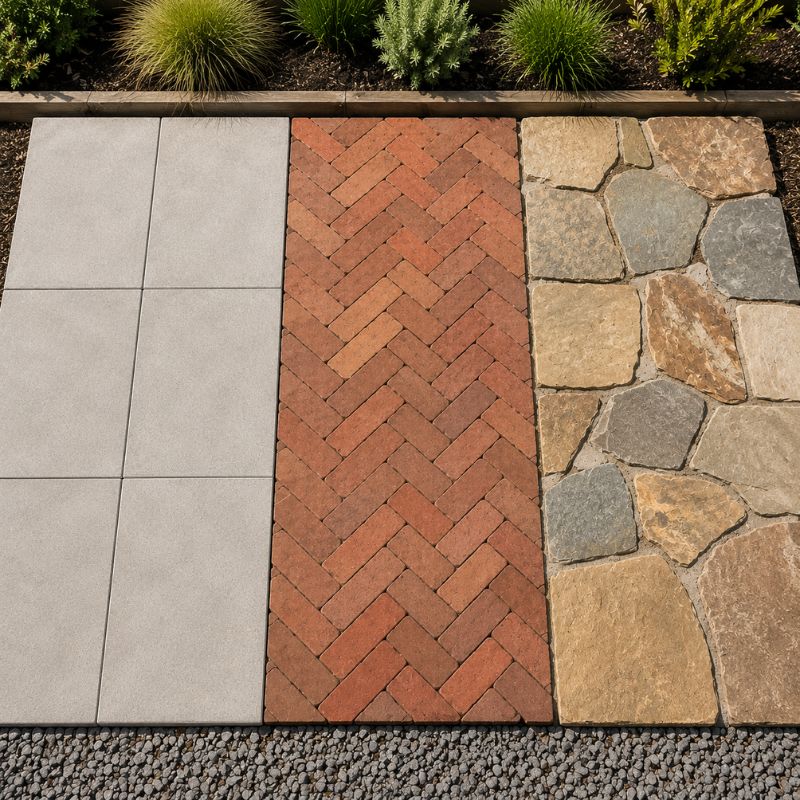
The pavers you pick change the look, the cost and how much upkeep you are signing up for. There is no single best option. Brick paving reads warm and traditional, natural stone looks the part but costs more, and concrete pavers give you the widest range for the money. Here is how the common choices compare for a Penrith home.
| Paver type | Best for | Look and upkeep | Worth knowing |
|---|---|---|---|
| Concrete pavers | Driveways, patios, paths, budget-conscious jobs | Huge range of shapes and colours, low upkeep | The all-rounder. Strong, consistent and the best value for most Penrith paving. Colour can soften over years. |
| Clay brick pavers | Traditional homes, paths, feature areas | Warm tones that hold their colour, minimal upkeep | Brick paving keeps its colour far longer than concrete because the tone runs right through the clay. A classic, tidy finish. |
| Natural stone | Feature patios, entries, high-end finishes | Premium look, each piece unique, some sealing | Sandstone, bluestone and travertine look superb but cost more and usually want sealing. Best where the finish really matters. |
| Porcelain pavers | Modern patios, alfresco, indoor-outdoor flow | Sharp, uniform, very low maintenance | Large-format porcelain gives a clean contemporary look and shrugs off stains, but needs an experienced hand to lay flat. |
| Exposed aggregate | Driveways, larger poured areas | Textured, grippy, low upkeep | A poured concrete finish rather than a laid paver. Hard-wearing and slip-friendly. Ask us whether this suits your job. |
The pavers you pick change the look, the cost and how much upkeep you are signing up for. There is no single best option. Brick paving reads warm and traditional, natural stone looks the part but costs more, and concrete pavers give you the widest range for the money. Here is how the common choices compare for a Penrith home.
What We Pave
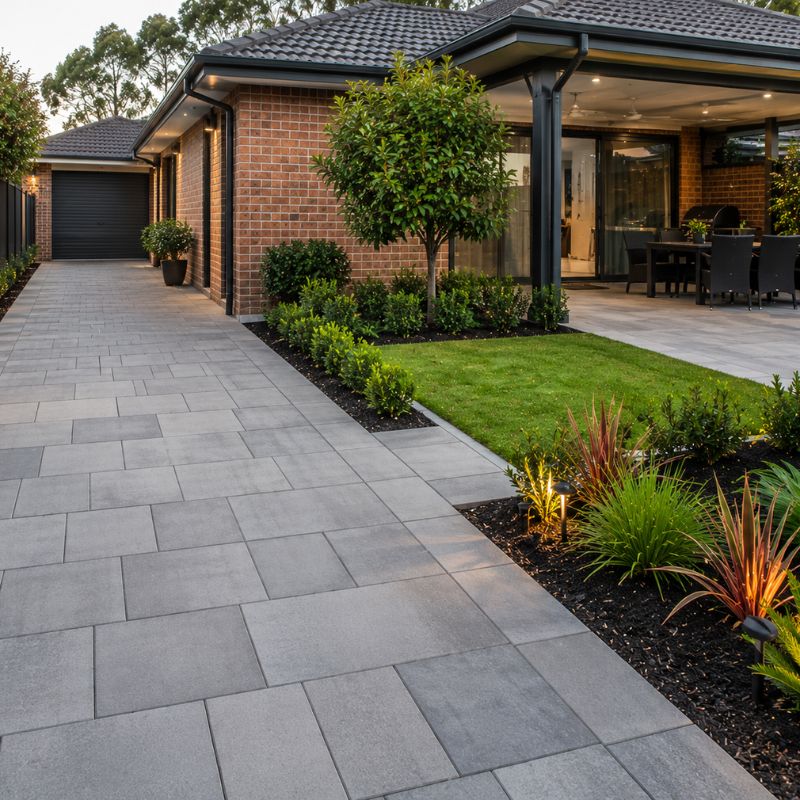
Paving covers a lot of ground, from the driveway out front to a quiet garden path down the side. Here is the paving we take on around Penrith.
Driveway paving
Patio paving
Pathways and garden paths
Backyard and entertaining areas
Pool surrounds and coping
Residential and commercial paving
How We Lay Paving: The Base Does the Work
Ask why a paved area failed and the answer is nearly always the base, not the pavers. Pavers laid on loose sand over soft ground will move. So most of the effort on a good paving job happens before a single paver is placed. Here is how we run it.
01
Set out and measure
We mark the area, check the levels and work out the falls, then confirm the material, the pattern and how many pavers the job needs so nothing runs short halfway.
02
Excavate to the right depth
We dig out the topsoil and soft ground to the depth the job calls for. A path needs less than a driveway carrying a car, and we cut each to suit.
03
Lay and compact the base
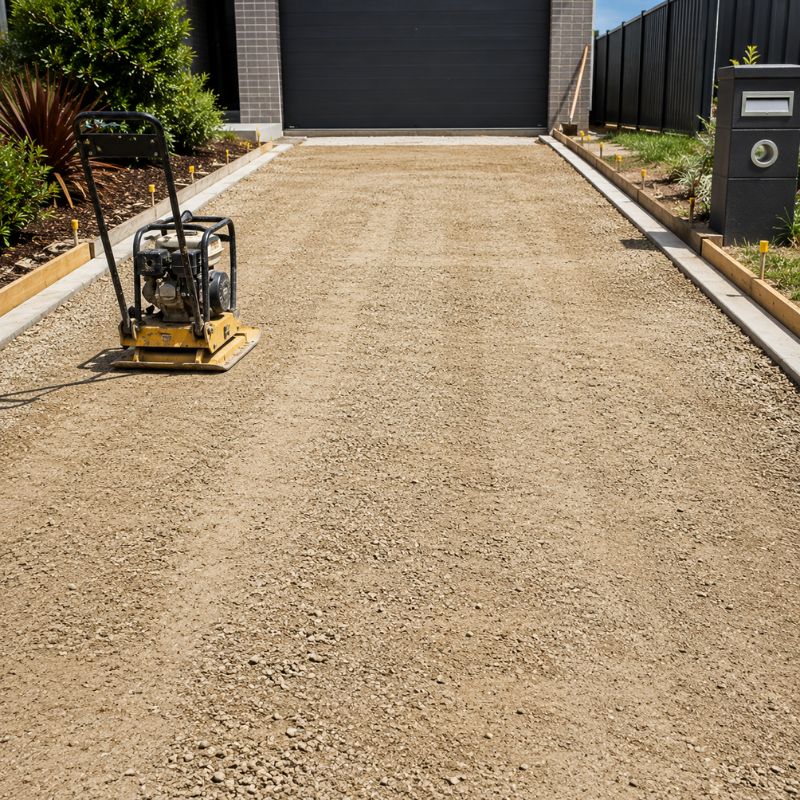
Road base goes in and gets compacted in layers with a plate compactor. This is the step that carries the load. Skimp here and the surface fails, no matter what sits on top.
04
Set the falls and lay the pavers
A screeded bedding layer, then pavers laid to the pattern with tight joints and the fall running away from the house so water drains instead of pooling.
05
Joint, compact and clean up
Joints are filled and locked, edges restrained, the surface given a final compact, and the site swept and cleared so it is left ready to use.
Driveway Paving
A driveway takes the hardest hammering of any paving on the block. A car parked on it day in, day out, plus the odd delivery truck, will find every weak spot in a poorly built base. That is why driveway paving gets a deeper excavation and a thicker compacted base than a path or patio, with pavers rated to carry vehicle loads.
Get it right and a paved driveway lifts the whole front of the house and lasts for decades. Get the base wrong and you get ruts where the wheels sit, pavers that rock, and weeds pushing through open joints within a year or two.
One thing worth knowing before you start: where a new driveway meets the kerb or crosses the footpath, the work on that public section sits inside the road reserve, and that part needs Council sign-off. Penrith City Council sets out the rules and the driveway application on its roads, paths and driveways page. We build to those requirements and can point you to the right application so the layback and crossing are done by the book.
Paving Is One Part of the Whole Garden
Paving rarely turns up on its own. A new patio often wants fresh turf beside it, a driveway might need a retaining wall to hold a bank, and bare beds around the edges always look better mulched. Doing it in the one project saves you lining up three separate crews and hoping the finishes match.
Clients regularly pair paving with new turf laying to frame the paved area, with retaining walls where the ground needs holding, and with mulching to finish the beds around it. Ongoing garden maintenance and weeding keep the whole lot looking sharp. Because we run the wider landscaping, paving can be one piece of a full garden refresh rather than a standalone call-out.
Licensed, and Done to Standard
Paving is trade work, and in NSW it is regulated once the job gets past a certain size. Any residential paving valued over 5,000 dollars in labour and materials must be carried out by a licensed contractor. Paving sits in the structural landscaping category, which the NSW Government’s structural landscaping licence page lists alongside driveways, paths and retaining walls. Using an unlicensed operator on a job that needs a licence puts you on the wrong side of the Home Building Act, so it pays to check.
Beyond the licence, good paving follows the same practical rules the trade has settled on over years: build the pavement to the guidance in AS 3727.1, the Australian standard for residential pavements, and pick surfaces with sensible grip. Around pools and wet paths, slip resistance is rated under AS/NZS 4586, and we steer you toward pavers with the right rating for a spot that gets wet, rather than a glossy tile that turns into a skating rink.
Patios, Paths and Entertaining Areas
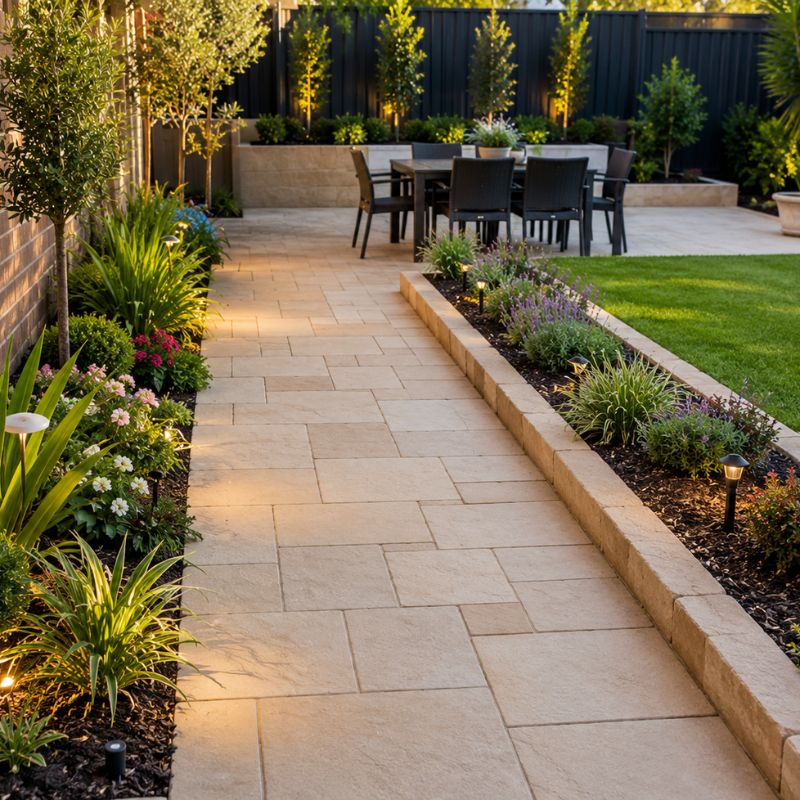
Not every paving job is out the front. Plenty of the best work happens in the backyard: a patio off the back door, a garden path winding through the beds, a courtyard set up for a table and a few chairs.
Patio paving turns a patchy bit of lawn into a proper outdoor room you can actually use. Garden paving and pathways give you a clean, mud-free run to the shed, the clothesline or the veggie patch, and they stop the lawn wearing into a dirt track along the route everyone walks. Get a path set on a firm base with proper edge restraints and it holds its shape instead of drifting apart at the sides.
Because this is landscape paving rather than just a slab, we think about how the paved area sits against the garden. Outdoor paving that meets the turf cleanly, curves around a bed, or steps down to a lower level reads far better than a hard edge dumped in the middle of the yard.
Areas We Service Across Penrith
Green Garden Landscapers lays paving for homes and businesses right across Penrith. Suburbs we cover include:
- Agnes Banks
- Berkshire Park
- Caddens
- Cambridge Gardens
- Cambridge Park
- Castlereagh
- Claremont Meadows
- Colyton
- Cranebrook
- Emu Heights
- Emu Plains
- Erskine Park
- Glenmore Park
- Jamisontown
- Jordan Springs
- Kemps Creek
- Kingswood
- Leonay
- Llandilo
- Londonderry
- Mount Vernon
- Mulgoa
- North St Marys
- Orchard Hills
- Oxley Park
- Penrith
- Regentville
- South Penrith
- St Clair
- St Marys
- Wallacia
- Werrington
- Werrington County
- Werrington Downs
Send us a Message
Paving in Penrith: Common Questions
How much does paving cost in Penrith?
It depends on the area, the paver you choose and how much prep the ground needs. As a rough guide, supplied and laid paving in the Penrith area often runs from around 80 dollars a square metre for basic concrete pavers up past 150 or more per square metre for natural stone, before any extra excavation or drainage. A driveway costs more per metre than a simple path because the base is deeper and the pavers are heavier. We measure the site and give you an itemised quote before anything starts, so there are no surprises.
What is the best paver for a driveway?
For a driveway you want a paver rated to carry vehicle loads on a properly built base. Concrete pavers are the usual pick because they are strong, come in every shape and colour, and give the best value. Clay brick pavers work well too and hold their colour longer. The paver matters, but the base matters more: even the toughest paver will rut if the ground underneath was not excavated and compacted properly.
Pavers or a concrete slab, which is better?
Both have their place. A plain concrete slab can be cheaper up front, but if it cracks you are looking at cutting out and repouring. With pavers, a damaged one lifts out and gets replaced in minutes, and the joints handle ground movement better. Pavers also give you far more choice in look and colour. For most residential driveways and patios in Penrith, quality pavers on a good base are the more forgiving long-term option.
How long does paving last?
Laid properly on a compacted base, a paved area comfortably lasts decades. The pavers themselves rarely wear out. What fails jobs is a rushed base, no edge restraints or bad drainage, which lets pavers sink, spread and let weeds through. Do the groundwork right and the main upkeep is the occasional joint top-up and a clean.
Do I need council approval to pave?
Paving within your own property, like a patio or a backyard path, is usually straightforward. The part that needs Council involvement is where a driveway crosses the footpath or kerb, since that section sits in the road reserve and requires a driveway application to Penrith City Council. We build to Council’s requirements and can point you to the right application for the crossing.
Why do pavers sink or come loose?
Almost always the base. If the ground was not excavated deep enough, or the road base was not compacted in layers, or there were no edge restraints to hold the pavers in, the surface starts to move. Water pooling under a poorly drained area speeds it up. The fix is not more pavers, it is doing the base right in the first place, which is exactly where we put the effort.
Do you offer paving services near me?
If you are in Penrith or a nearby suburb and searching for paving contractors near me or paving services near me, yes. Send through your address and a couple of photos of the area, and we will sort out a site visit and a clear quote.
Why Choose Green Garden Landscapers
Anyone can lay pavers on a bit of sand. The difference is in the base, the drainage and the finish, and in being a paving crew that also understands the garden the paving sits in.
- Paving built base-first, so it stays flat and does not sink or shift
- Falls and drainage set properly, so water runs off instead of pooling
- Honest material advice across concrete, brick, stone and porcelain pavers
- Paving installers who tie the work into your turf, beds and edges
- One crew for the paving and the landscaping around it
Whether it is a single garden path or a full driveway and patio, our paving specialists give you a clear quote and a job built to last.
Ready for paving that stays put?
Tell us about your driveway, patio or path and we will book a site visit and a clear quote.
